




What Ghostbusters Teaches Dungeon Masters About Supernatural Adventures
There are plenty of movies about heroes who save the world from supernatural evil. There are far fewer about heroes who have to figure out how to capture that evil, pay the bills, repair their equipment, and convince the authorities that the giant marshmallow creature stomping through the city is a legitimate business expense. Last week we delved into the Oceans movies and running a campaign like a heist movie, but this is a whole different level of threat.
That’s part of what makes Ghostbusters such a fantastic source of inspiration for Dungeons & Dragons.
Peter Venkman, Ray Stantz, Egon Spengler, and Winston Zeddemore aren’t traditional fantasy heroes. They’re scientists, investigators, and paranormal exterminators who have turned their unusual expertise into a business. They don’t set out to become legendary champions. They see an opportunity, develop a specialized solution, and discover that their chosen profession is considerably more dangerous than the advertisements suggested.
Their adventures are full of supernatural threats, strange discoveries, dangerous equipment, and plans that go spectacularly wrong. Yet beneath the comedy is a remarkably useful lesson for Dungeon Masters: a supernatural adventure becomes more interesting when defeating the monster is only one part of solving the problem.
If you want to run better D&D encounters, memorable investigations, or an entire campaign centered on strange magical phenomena, there’s a lot to learn from the Ghostbusters.
Your Players Don’t Always Need to Fight the Monster
One of the first assumptions many D&D players make when they encounter a monster is that they’re supposed to kill it. The creature has a stat block, the characters have weapons and spells, and eventually somebody rolls initiative.
That works wonderfully for some encounters. But supernatural adventures become much more interesting when the goal isn’t necessarily to destroy whatever the characters discover.
What if the objective is to capture a ghost? What if the creature is bound to a particular location? What if it can only be harmed by a very specific method? What if attacking it simply makes the situation worse?
The Ghostbusters don’t approach every haunting as a conventional fight. Their equipment is designed to contain supernatural entities, and their investigations are often about figuring out what they’re dealing with before they can do anything useful about it.
A Dungeon Master can borrow this approach without needing to redesign the entire combat system.
Imagine the party enters an abandoned manor where a spectral knight has been terrorizing the surrounding village. The obvious solution is to destroy the undead creature. But what if the knight cannot be permanently defeated until someone recovers the remains of the person he failed to protect? What if attacking him causes the manor’s other spirits to become hostile? What if the knight isn’t the source of the haunting at all, but the only thing keeping something worse imprisoned beneath the house?
Now the players need to investigate, experiment, and discover how the supernatural problem works. Combat might still happen, but it is no longer the only tool available to them.
That distinction can transform a routine encounter into an adventure.
Make Investigation Part of the Fun
The Ghostbusters don’t simply wander around New York waiting for ghosts to appear. They investigate unusual activity, follow reports, examine evidence, and try to understand the phenomena they’re encountering.
This is an excellent model for D&D adventures involving hauntings, curses, strange creatures, and magical disturbances.
Instead of having an NPC explain exactly what’s happening, give the players evidence they can interpret. A village reports that every mirror in a particular district has begun showing a different room. Livestock disappear without leaving tracks. A local cemetery has become unnaturally warm. People hear familiar voices coming from sealed wells.
Each clue should give the players something useful while raising new questions.
Perhaps the mirrors show the same room because it exists in a pocket dimension. Perhaps the missing livestock are being pulled underground by an invisible creature. Perhaps the cemetery’s temperature is rising because an ancient fire elemental is awakening beneath it.
The players don’t need to solve every mystery through ability checks. Let them ask questions, compare observations, test theories, and make deductions. Ability checks can supply information they might otherwise miss, but they shouldn’t replace the players’ opportunity to engage with the mystery.
One of the most satisfying moments in a supernatural adventure is when the party finally understands what’s happening and realizes that the clues were pointing toward the answer all along.
The trick is to make investigation produce actionable information. Discovering that a ghost is connected to an old murder is interesting. Discovering that the ghost becomes vulnerable whenever the murder weapon is brought into the room gives the players something they can actually use.
Give the Party Specialized Tools

The Ghostbusters have proton packs, ghost traps, containment equipment, and an assortment of devices designed to detect or interact with supernatural phenomena. Their gear doesn’t make them invincible. It gives them options.
D&D already has an enormous collection of magical equipment, but Dungeon Masters can make unusual adventures more interesting by introducing tools designed for a particular problem.
Imagine giving the party a lantern that reveals invisible spirits but attracts them whenever it’s lit. Or a set of silver bells that can temporarily anchor a ghost to the physical world. Perhaps the characters acquire a portable containment vessel that can imprison a supernatural creature, but its capacity is limited and every captured entity makes the vessel more unstable.
These tools create choices instead of simply increasing damage.
The lantern helps the party locate an invisible stalker, but using it might draw the creature toward them. The bells make a ghost vulnerable, but somebody must keep ringing them while the others work. The containment vessel can solve the immediate problem, but the party must decide whether to risk carrying a dangerous entity back to civilization.
Good equipment changes how players approach a challenge.
It also gives them reasons to cooperate. One character operates the device, another protects them, and a third figures out how to exploit the creature’s weakness. Suddenly, an encounter feels less like four people taking turns attacking a target and more like a team trying to accomplish something under pressure.
Let Things Go Wrong Without Ending the Adventure
A defining feature of Ghostbusters is that the plan rarely works exactly as intended. Equipment malfunctions, supernatural forces behave unexpectedly, and seemingly manageable problems escalate into citywide disasters.
That is excellent material for a D&D session, provided the Dungeon Master understands the difference between a complication and a dead end.
A failed roll shouldn’t always mean the characters can’t continue. Sometimes it means they can continue, but the situation has become more dangerous.
The party attempts to contain a ghost, but the trap activates before the creature is inside. A wizard tries to suppress a magical disturbance and accidentally causes it to spread. The characters successfully identify a demon’s weakness, but their research alerts the cult that summoned it.
The original objective remains possible. The players simply have a new problem to solve.
This is especially effective when the consequences follow naturally from the characters’ actions. A failed experiment might release magical energy. A noisy infiltration might attract a curious creature. A rushed exorcism might break the wrong part of an ancient binding.
The best complications don’t feel like the Dungeon Master arbitrarily punishing the players. They feel like the consequences of dealing with dangerous things that nobody completely understands.
And sometimes, as the Ghostbusters demonstrate, a small mistake can become an enormous problem.
Comedy Doesn’t Mean There Are No Stakes
One of the most useful things D&D can borrow from Ghostbusters is its ability to make a ridiculous situation genuinely dangerous.
A supernatural extermination business is inherently funny. The heroes have uniforms, advertisements, equipment, and invoices. They also deal with creatures that can possess people, terrorize neighborhoods, and potentially destroy the world.
The comedy works because the danger is real even when the circumstances are absurd.
Dungeon Masters sometimes struggle with this balance. A campaign can become so serious that every NPC speaks as though delivering a prophecy, or it can become so silly that players stop taking anything seriously. Neither approach is inherently wrong, but mixing humor with genuine consequences can create a wonderful tone for a campaign.
A village might hire the party to remove a poltergeist that keeps throwing furniture at the mayor. The investigation reveals that the spirit is furious because the mayor built his office over its grave. The party might find the situation amusing, but the spirit is still dangerous, the mayor is still hiding something, and the village still needs help.
The humor makes the adventure memorable. The stakes give the characters a reason to care.
You can also let the players create the comedy themselves. A failed spell, an overconfident NPC, or an improvised plan can produce a hilarious moment without requiring the Dungeon Master to turn every encounter into a joke.
The goal isn’t to make the world ridiculous. It’s to let ridiculous things happen in a world where actions still matter.
The Business of Being an Adventurer
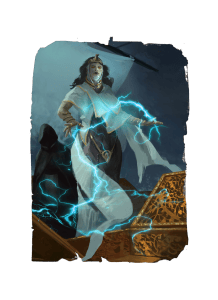
In Procession, characters will encounter Apophis and the ghostly ship she apparates upon. What happens next is up to the group. Just one of many D&D encounters in Out of the Box: Encounters for 5th Edition on Kickstarter. [Art by Kim Van Deun]
D&D campaigns don’t need to track every copper piece spent on lodging, but this idea can create an interesting campaign framework.
What if the party operates a monster-hunting business? What if they are specialists hired to investigate magical disturbances? What if a local guild sends them contracts involving haunted buildings, cursed objects, and creatures that ordinary guards can’t handle?
Now the characters have reasons to accept adventures beyond the promise of treasure.
A wealthy noble might pay them to remove a ghost from an ancestral estate. A village might offer only food and lodging because it can’t afford professional help. A temple might hire them to recover a possessed relic before it corrupts the surrounding countryside.
Each job can become a self-contained adventure while contributing to the campaign’s larger story.
The business itself can generate complications, too. A rival company might claim the party’s discoveries as its own. A captured monster might escape containment. A client might refuse to pay after the job is complete. A supposedly harmless object might turn out to be the most dangerous thing the party has ever encountered.
This structure also gives players meaningful choices about how they want to operate. Do they charge wealthy clients more to subsidize work for poorer communities? Do they specialize in particular kinds of supernatural threats? Do they take dangerous jobs for prestige or stick to reliable contracts?
The campaign becomes about more than completing quests. It becomes about building something together.
Make the Supernatural Rules Consistent
The Ghostbusters encounter strange phenomena, but the world feels more convincing because the characters can investigate those phenomena and learn how they work.
This is an important principle for D&D mysteries.
You can create almost any supernatural threat you want, but the players need some way to understand it. If a ghost is immune to mundane weapons, vulnerable to a particular magical effect, and capable of possessing objects, those properties should remain consistent enough that the players can form a plan.
That doesn’t mean every creature needs a detailed scientific explanation. Mystery is valuable. But the characters should be able to discover reliable information.
Perhaps a ghost can only manifest near an object connected to its death. Perhaps a cursed sword grows stronger each time it draws blood. Perhaps a magical anomaly reacts to spells cast within its radius.
Once the players discover the rules, they can use that knowledge to make decisions.
This is also a great opportunity to reward experimentation. If the wizard tries a harmless cantrip against a strange magical phenomenon, provide some indication of how it responds. If the rogue throws a mundane object into a haunted room, let the party learn something from what happens.
The players are testing hypotheses, and their discoveries should matter.
The most satisfying supernatural encounters allow the party to understand enough of the problem to develop a solution, even if that solution is dangerous or difficult to execute.
Escalate the Problem, Not Just the Monster
A common approach to increasing the difficulty of an adventure is to introduce a more powerful creature. The party defeats a ghost, then encounters a stronger ghost. Later, they fight an even stronger ghost.
That can work, but the Ghostbusters offer another approach: the original problem grows beyond what anyone expected.
A strange haunting becomes a neighborhood crisis. The neighborhood crisis reveals a citywide supernatural disturbance. The disturbance turns out to be connected to an ancient force that has been waiting for the right conditions to return.
The threat escalates because the characters discover that the situation is larger than they understood.
You can use this structure over a single session or an entire campaign. The first adventure might involve a haunted tavern. The second reveals that similar hauntings are occurring across the region. The third uncovers a pattern connecting the locations. Eventually, the party realizes that the disturbances are not separate incidents but symptoms of something much larger.
Each adventure should still have its own objective and resolution. Players need to feel that their victories matter. But those victories can reveal new information, introduce new complications, and give the campaign a growing sense of momentum.
The trick is to let the situation escalate logically rather than simply making every new monster bigger than the last.
Let the Players Invent the Solution

Desert echoes are one of the ghostly new monsters lurking in the temple beneath the Forgotten Oasis. [Art by Nelson Vieira]
D&D players are remarkably inventive when they believe the Dungeon Master is genuinely interested in their ideas. If every supernatural encounter has one predetermined solution, players quickly learn that their creativity has limited value.
Instead, establish the problem, provide useful information, and let them figure out what to do.
The party might trap a spirit inside a mirror, lure a monster into an abandoned temple, redirect a magical current, or convince a ghost to cooperate with its own exorcism. Some plans will be brilliant. Others will fail spectacularly. Both can produce memorable sessions.
As a Dungeon Master, you don’t have to approve every idea automatically. Consider what the characters know, what resources they have, and whether their approach could reasonably work. Ask for appropriate checks when success is uncertain, and allow consequences to emerge from the outcome.
But resist the urge to reject a solution simply because it isn’t the one you imagined.
Sometimes the most memorable part of an adventure is watching the players solve a problem in a way you never anticipated.
After all, the characters are the heroes of the story. They should have a chance to surprise you.
Your Next Supernatural Adventure
Ghostbusters is more than a movie about people catching ghosts. It’s a story about specialists confronting problems that don’t fit neatly into ordinary categories. The heroes investigate, experiment, build tools, make mistakes, and discover that understanding a problem can be just as important as having the power to defeat it.
Dungeon Masters can bring that same approach to almost any D&D campaign.
Make investigation meaningful. Give players tools that create choices. Let failed rolls complicate the situation instead of bringing the adventure to a halt. Mix humor with genuine danger. Give the characters reasons to care about the practical consequences of their work. Most importantly, let them discover how the supernatural threats in your world actually function.
You don’t need to run a campaign about paranormal exterminators to use these lessons. A haunted castle, a cursed artifact, a village plagued by strange creatures, or a wizard’s experiment gone wrong can all benefit from this style of adventure.
The next time your players encounter something strange, resist the temptation to reveal a monster and immediately call for initiative.
Give them a clue.
Give them a problem.
Give them a few tools and a little time.
Then see what they come up with.
Just remember to make sure somebody checks the containment unit before the party heads home.
Thanks for reading. Until Next Time, Stay Nerdy!!

No Comments